

What Picasso Saw on the Street
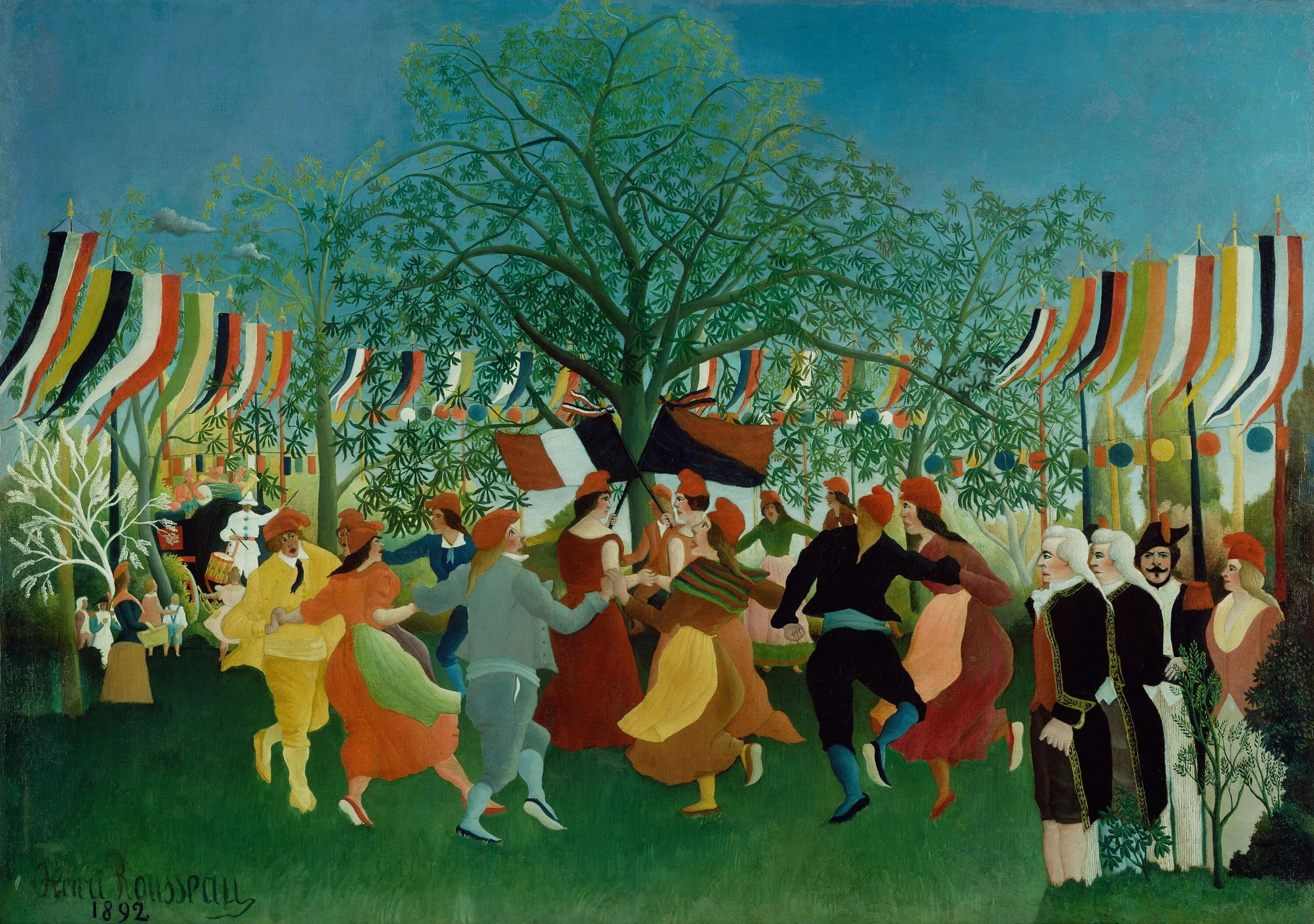
Henri Rousseau, A Centennial of Independence, 1892. The J. Paul Getty Museum (88.PA.58).
On First Glance
A Centennial of Independence should not work. Figures circle in a ring dance around three liberty trees, their proportions loose, their feet barely touching the ground, flags and banners hanging in rows that feel more like wallpaper than wind. Henri Rousseau painted this in 1892 with no academic training, no formal understanding of perspective, and complete conviction. That tension is exactly what makes it worth looking at slowly.
The Flat and the Festive: Reading Color Without Shadow
Rousseau painted methodically, applying colors one at a time and working from the top to the bottom of the canvas. You can almost feel that process here. The sky sits in a single clean wash of teal. The chestnut tree, impossibly dense and symmetrical, anchors the center. The grass is one unbroken plane of green. There is no atmospheric haze, no recession of tone. Where a trained academic painter would have softened the background into distance, Rousseau held every element at the same intensity. The result is less like looking through a window and more like looking at a tapestry.
Accidental Avant-Garde
This flatness, which critics mocked as childish, was exactly what drew Picasso and Kandinsky to his work. His work's unschooled technique and sense of childlike simplicity resonated with the primitivism embraced by early-20th-century modern artists who were actively trying to unlearn academic convention. Rousseau arrived there without trying. The dancers in their orange and yellow skirts, the red Phrygian caps, the impossible symmetry of the flags: none of it obeys the rules of chiaroscuro or foreshortening, and all of it vibrates with strange joy.
Joy as Political Statement
This is a painting about the French Republic turning one hundred. But Rousseau was not interested in grandeur or monumentality. He reached instead for something almost folk in feeling, closer to a village fête than a state ceremony. That choice, whether conscious or not, says something. Greater attention is paid to the details of costume than to the figures themselves, and that priority is itself a kind of politics: the people matter more than their poses.