

The Autopsy of a Holiday Icon Paul McCarthy at Hauser and Wirth Paris
Paul McCarthy has spent more than five decades making work that refuses to be comfortable. Born in Salt Lake City in 1945, he emerged from the West Coast performance art scene of the 1970s, building a practice rooted in abjection, body horror, and the grotesque underbelly of American consumer culture. He is represented by Hauser and Wirth, one of the most powerful commercial galleries in the world, a fact that carries its own irony given that McCarthy's entire project is an assault on the systems that make galleries like Hauser and Wirth possible.
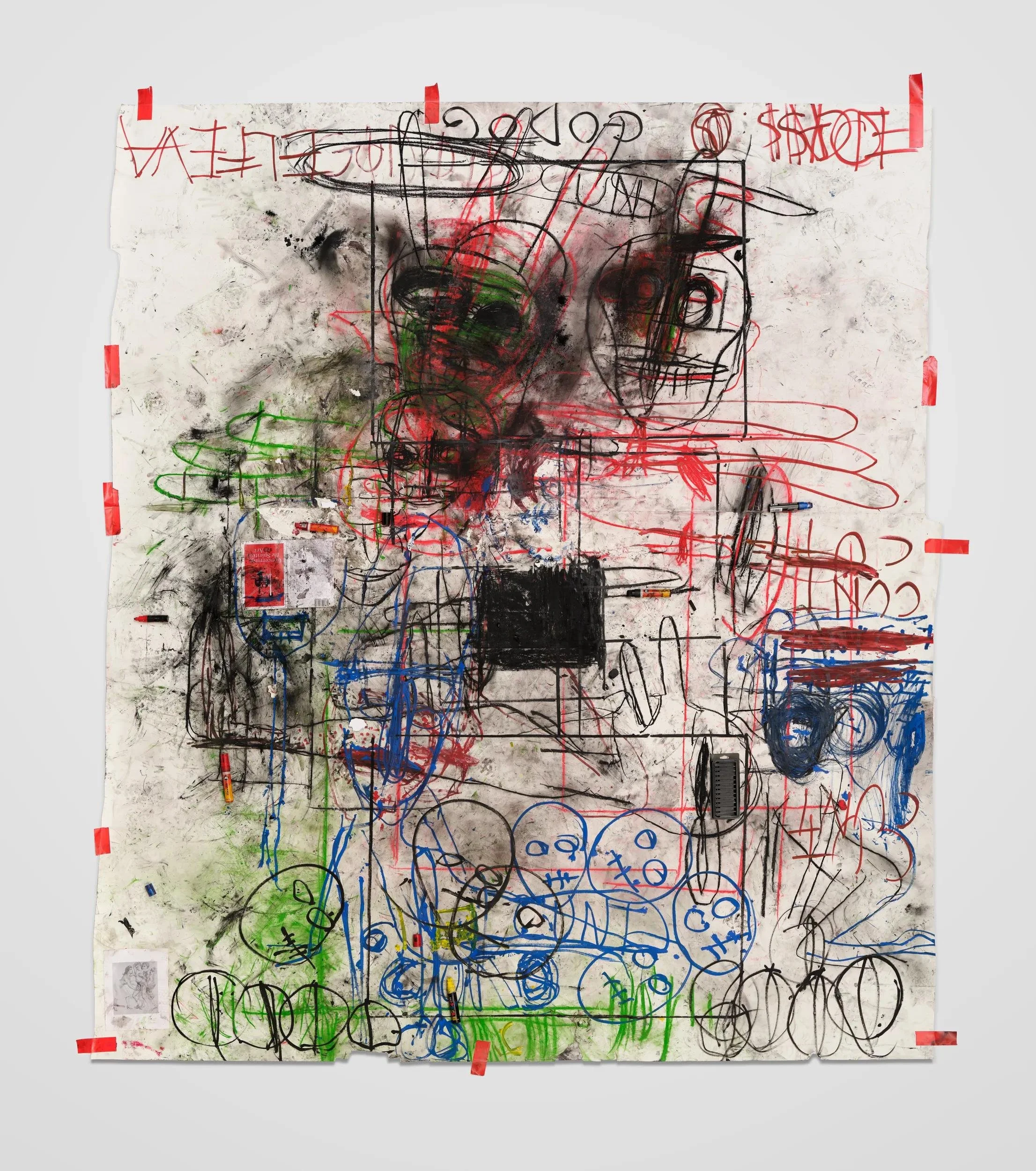
© Paul McCarthy. Courtesy the artist and Hauser & Wirth. Photo: Fredrik Nilsen.
SS EE Saint Santa Eva Elf, currently on view at Hauser and Wirth Paris through May 30, 2026, is the latest chapter in his collaboration with German actress Lilith Stangenberg. The two inhabit the characters of Santa and the Elf across thirteen days of filmed, unrehearsed performative drawing sessions staged inside a full-scale reconstruction of McCarthy's childhood home in Salt Lake City, built inside his Los Angeles studio. The set was originally constructed for his 2012 White Snow series. It reappears here as something stranger, a domestic interior that is also a crime scene, a theatre, and a memory palace all at once.
The drawings that came out of these sessions are enormous, vertical, and feral. They recall Jean Dubuffet's Art Brut in their deliberate rejection of refinement, and push into territory closer to Jean-Michel Basquiat in their layering of text, symbol, and figuration. But the vertical, totem-like structure of these drawings also resonates with something older. The stacked faces and hierarchical arrangements of figures recall Japanese Oni masks and the tiered iconography of Buddhistthangka paintings, where figures are layered vertically to denote spiritual hierarchy. McCarthy almost certainly did not intend this, but the collision is worth sitting with. The grotesque in Eastern religious iconography has always carried moral weight. Here it carries commercial weight instead, which is perhaps McCarthy's point.
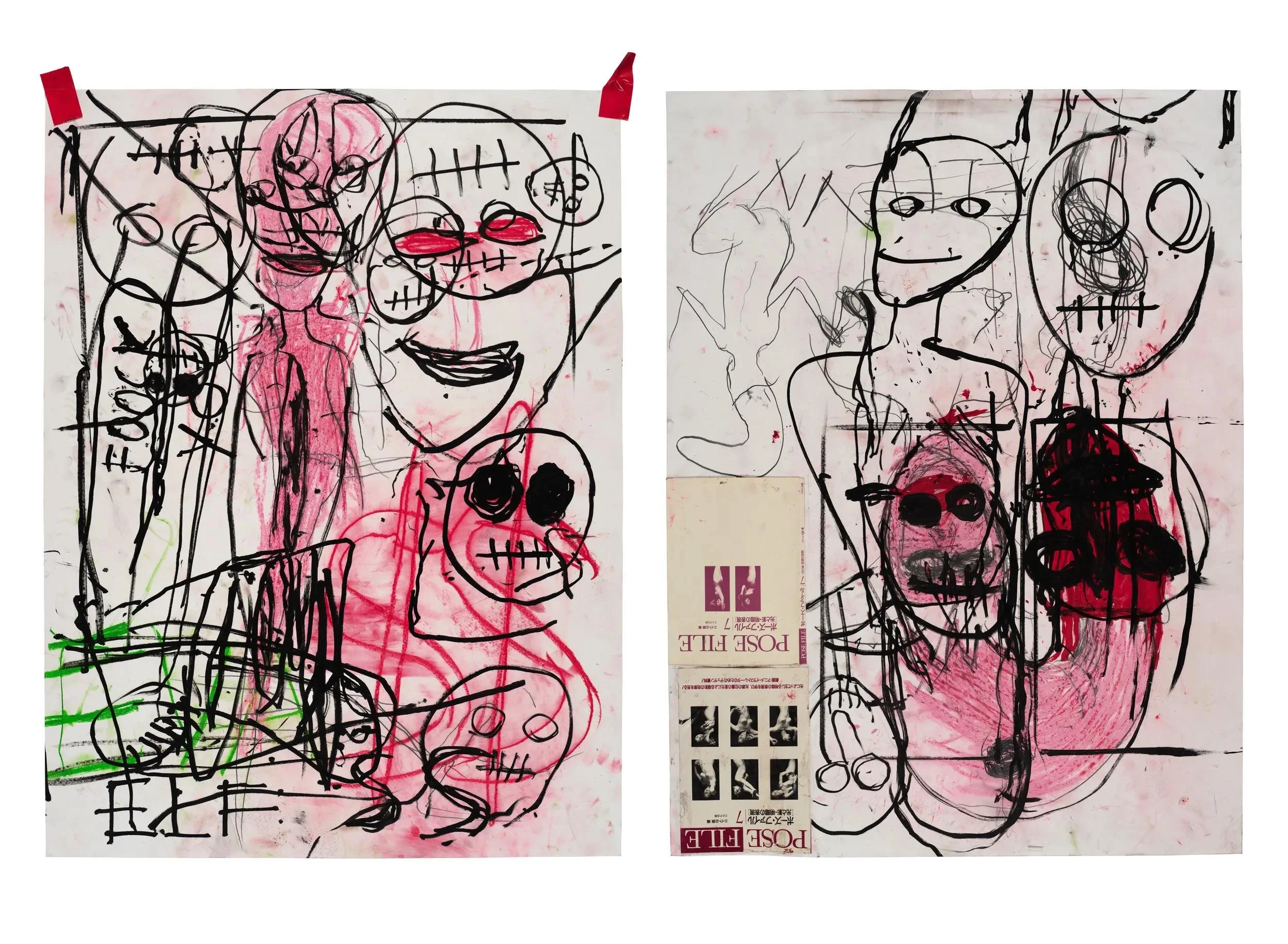
© Paul McCarthy. Courtesy the artist and Hauser & Wirth. Photo: Fredrik Nilsen.
Santa Claus has been in McCarthy's vocabulary since the 1990s. In his 1996 Tokyo Santa series he began dismantling the icon as a vessel for capitalist mythology, and Tokyo is not an incidental location in that title. Japan's absorption and transformation of Western consumer symbols, from Santa Claus to Kentucky Fried Chicken as a Christmas tradition, represents one of the most acute examples of what McCarthy is diagnosing. The psychosis of commodity culture does not respect borders. It is as present in Akihabara as it is in a mall in Utah. The red and green of the works are Santa's red and the Elf's green, colors that arrive pre-loaded with cultural memory across both hemispheres and are systematically destroyed across each sheet of paper.
The collaboration with Stangenberg adds a dimension that earlier solo work could not achieve. There is a power negotiation happening on the floor of the studio that bleeds directly into the surface of the drawings. It rhymes with Carolee Schneemann's body-as-canvas logic and with Hermann Nitsch's ritualized excess, but it also connects to the Japanese Gutai movement of the 1950s and 60s, where artists like Kazuo Shiraga painted with their bodies on the floor, treating the canvas as a site of physical confrontation rather than pictorial representation. McCarthy and Stangenberg are doing something related, though where Gutai sought liberation through the body, McCarthy seeks exposure of what the body has been made to perform.
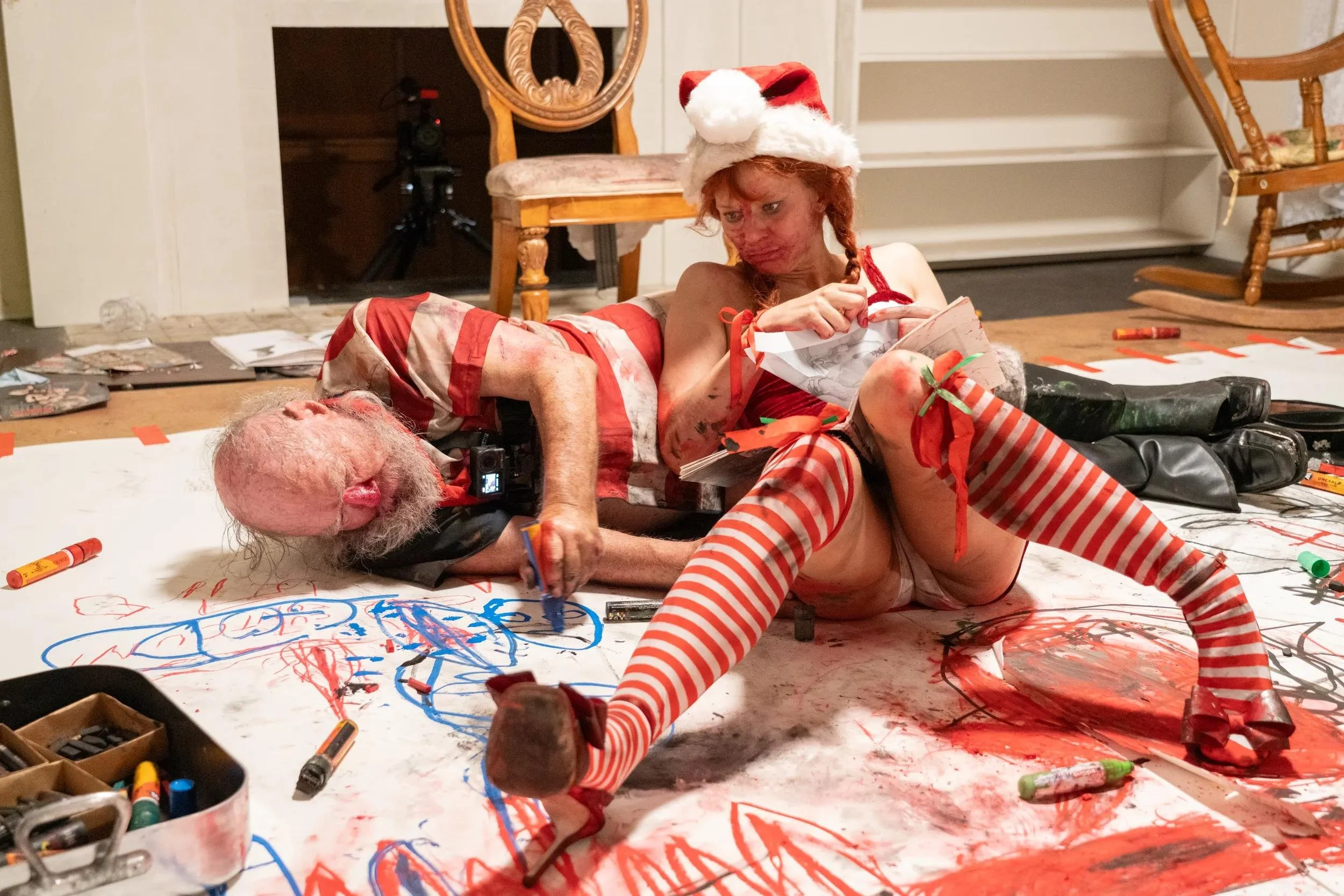
Paul McCarthy with Lilith Stangenberg, SS EE, Saint Santa Eva Elf, Drawing Session, 2025. Performance, video, photographs, installation. © Paul McCarthy. Courtesy the artist and Hauser & Wirth. Photo: Alex Stevens.
This is where the work becomes genuinely difficult and genuinely interesting. The performance photograph is not documentation. It is part of the work. McCarthy has said that the artist edits and the viewer edits, and that principle extends to how these images circulate. You are not looking at a record of something that happened. You are looking at another surface on which meaning is being made and unmade simultaneously. There is something here that also connects to the Chinese concept of 自发性, ziran, the Taoist principle of spontaneity and natural unfolding, though McCarthy weaponizes spontaneity rather than finding peace in it. The improvisation is not meditative. It is forensic.
McCarthy is not asking whether Santa is evil. He decided that forty years ago. He is asking what it costs to keep performing that knowledge, and whether art can sustain that cost without becoming what it criticizes.
Paul McCarthy, SS EE Saint Santa Eva Elf, Drawing Sessions 2025, with Lilith Stangenberg. Hauser & Wirth Paris, 21 March – 30 May 2026.