

A Hymn in Very Small Notes
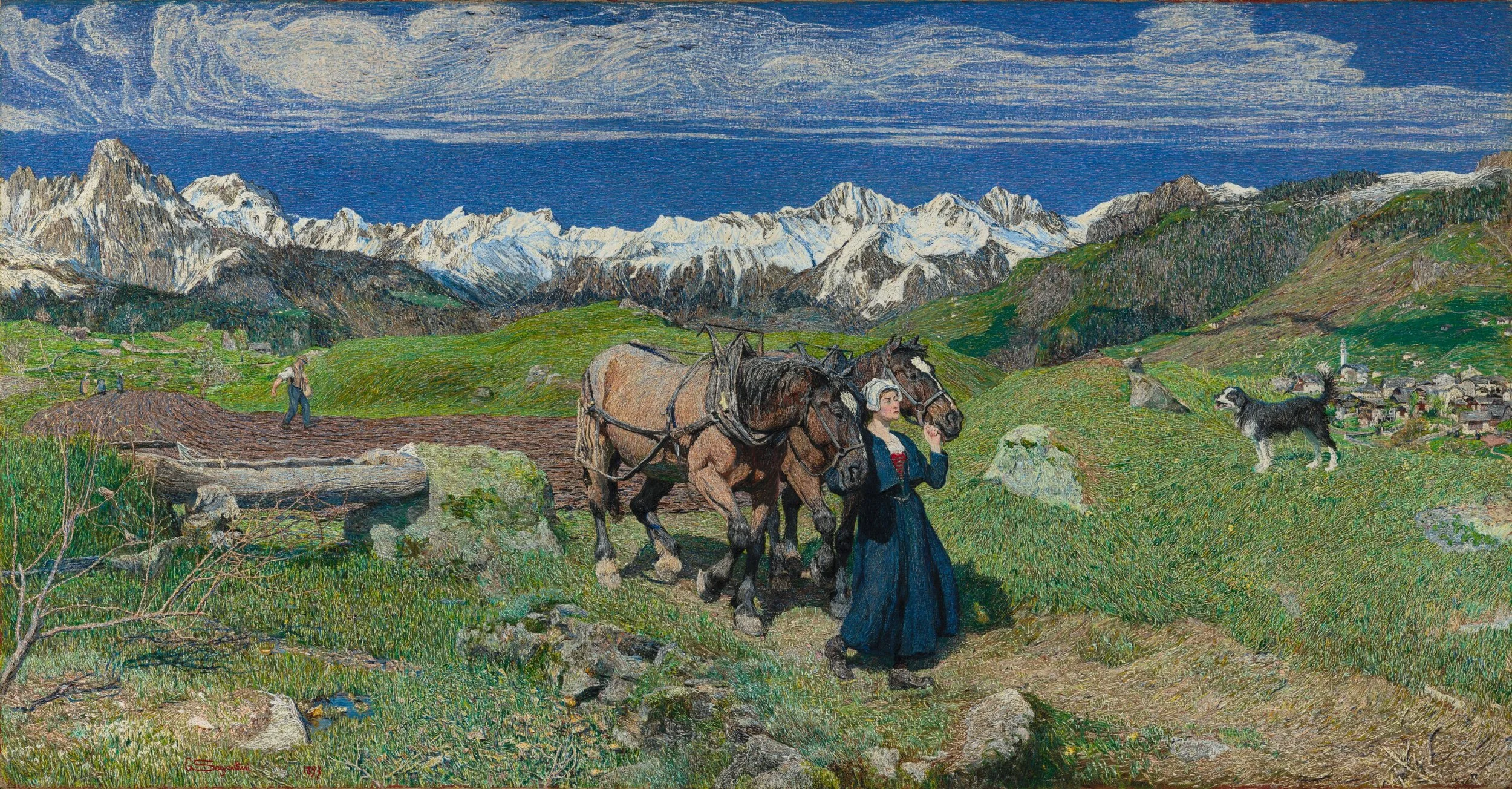
Giovanni Segantini, Spring in the Alps, 1897. The J. Paul Getty Museum (2019.3).
On First Glance: Labor as Subject
At first glance, Spring in the Alps reads like a love letter to physical labor and open air. A farm girl in the blue and red peasant dress of the Grisons canton leads two draught horses across a green plateau, a black-and-white dog alert at the far right, and a sower visible in the middle distance. But the longer you look, the more the surface itself becomes the subject.
Not Impressionism: The Italian Difference
Segantini was not painting in the Impressionist tradition as it was practiced in France or, later, in North America. This is Divisionism, the Italian variant of Neo-Impressionism: color applied in small, juxtaposed strokes or lines, unmixed on the palette, producing a luminous vibration effect similar to, but independent from, French Neo-Impressionism. Where Claude Monet dissolved form into atmosphere, and where Canadian artists of the Group of Seven later used bold, declarative brushwork to assert the wilderness as national identity, Segantini uses his filament-like strokes to slow you down, to make the grass almost audible in its particularity. The sky, an extraordinary ultramarine, is built from hundreds of tiny marks that feel closer to textile than paint.
The Weight Millet Left Behind
Thematically, the painting echoes Jean-François Millet's peasant dignity, though in Segantini's work the social dimension gives way to an existential and pantheistic meditation on the unity of man and nature. The Alps here are not backdrop. They are argument.
The Stroke as Architecture
The direction of his brushstrokes communicates form and controls the focal point in ways that feel almost architectural. North American Impressionism tended toward prettiness and leisure. Segantini's stroke insists on weight, on season, on the fact that the ground has just been turned.
This painting is a hymn sung very slowly, in very small notes.