

The Merchant, the Turban, and the Unexplained Note
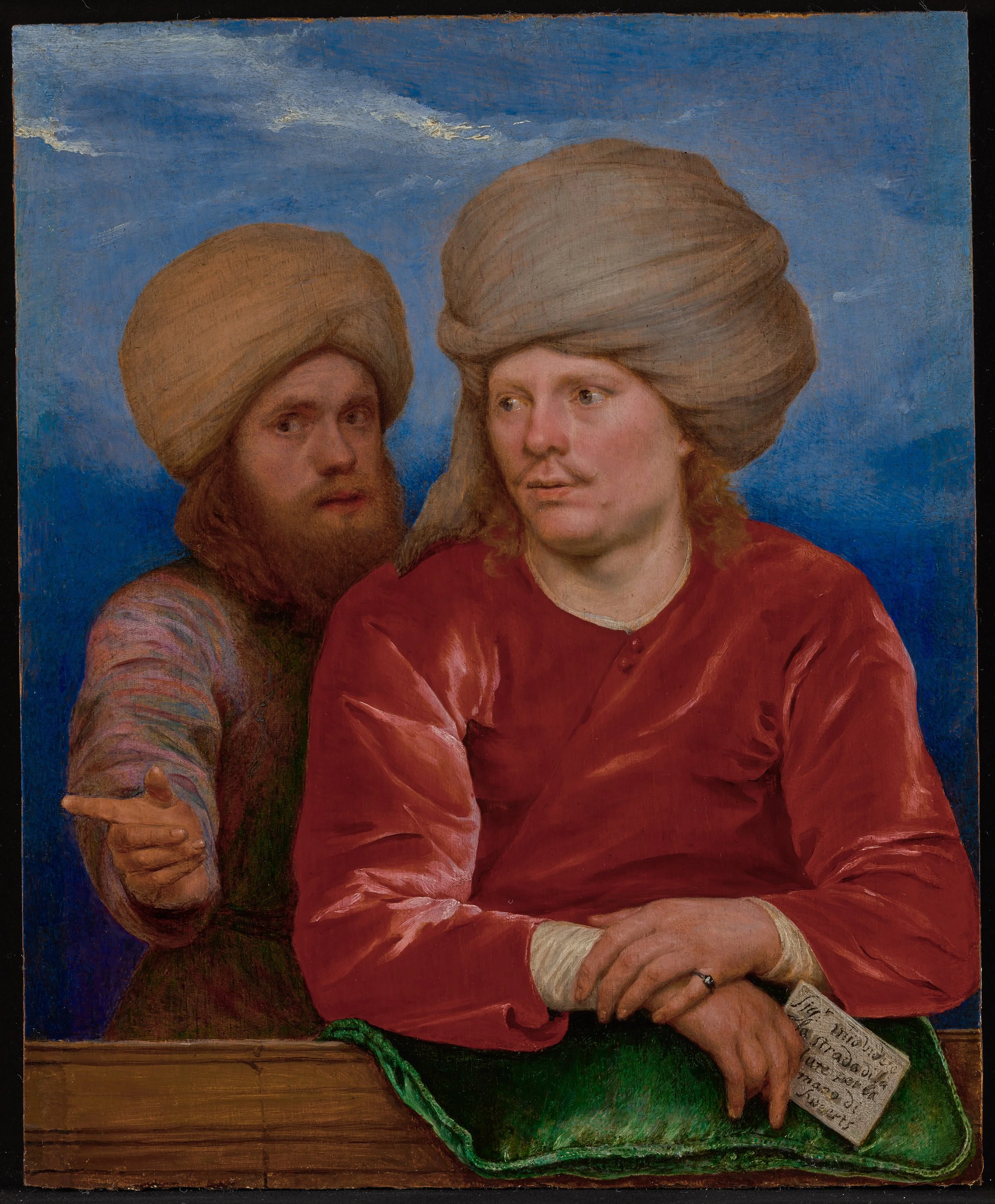
Michael Sweerts, Double Portrait, about 1660–1662. The J. Paul Getty Museum (85.PB.348).
Ottoman dress
Two very European-looking men are wearing Ottoman turbans. The dissonance is deliberate. The fashion was called turquerie, and among the Northern merchant class it functioned as a kind of wearable geography. Where Jan van Eyck's Flemish merchants wore fine wool to signal the textile wealth of their own cities, these men have dressed themselves in the East. The turban is not about cultural identification. It is about radius. My world is larger than yours, and I have the clothes to prove it.
Material objects
The foreground figure is built from objects that speak. The red garment is almost certainly silk, rendered with the same obsessive fidelity to sheen and fold that Vermeer brought to his domestic interiors, where fabric was never merely fabric but a precise index of household standing. The signet ring is small and easy to miss, placing its wearer inside a legal and commercial world where identity had to be sealed and contracts authorized. The green velvet cushion beneath his arms appears throughout Northern portraiture from Holbein onward as a prop with a single meaning: leisure that wealth has made possible. In his hand, a note written in Italian, the language simultaneously of international commerce and the Catholic Church. Sweerts is not painting a man. He is assembling an argument from objects.
Composition and light
The wooden ledge the figures lean against is a device borrowed from the trompe l'oeil tradition, creating the illusion that they occupy a balcony or window just beyond the picture plane. Painters used it to collapse the distance between viewer and subject. Here it reads equally as the rail of a ship: two men caught between departure and arrival, belonging fully to neither world, which is precisely what the turbans already suggested. The ledge confirms what the costume implied.
Light does its hierarchical work without announcing itself. The foreground figure absorbs it; the man behind recedes into comparative shadow. This is the compositional logic Sweerts inherited from Raphael's double portraits and later Pontormo, where spatial position and light together establish rank without requiring explanation. The technique is so deeply embedded in the visual grammar of early modern portraiture that it operates below conscious reading.
The background
Most painters of this period used near-black grounds, the convention established through Caravaggio and absorbed by Rembrandt and Velázquez, in which human presence emerges from darkness as a form of psychological weight. Sweerts opens the sky instead. He had spent formative years in Rome among the bamboccianti, painters of sunlit outdoor street life who refused the grandeur of history painting in favor of ordinary people in actual light. That training stayed with him. The blue ground is not an aesthetic preference but a position: these men exist in the world, under an open heaven, with somewhere to go. The darkness of the Baroque ground implies fate. The sky implies motion.
It is part of what has always drawn me to Sweerts. His Head of a Woman does not look like a painting from the 1600s. Where most of his contemporaries were locked into the visual conventions of the period, Sweerts kept finding ways to let air into the room.
The gesture
The bearded man behind the foreground figure carries an expression of urgency, almost alarm, that sits in the tradition of genre painting where psychological interiority was considered as worthy of depiction as aristocratic composure. His pointed finger directs attention toward something outside the frame. The gesture has a long genealogy in religious painting: in Caravaggio's Calling of Saint Matthew, figures point across the canvas toward the moment of divine summons. The pointing hand always indicates that something more important is happening elsewhere. Here, what it points to remains unresolved.
The inscription
Written in Italian, it addresses "my lord" and speaks of salvation by the hand of Sweerts himself. This is not a merchant's correspondence. It converts the painting from a friendship portrait into something closer to a donor portrait, that medieval and Renaissance tradition in which patrons inserted themselves into sacred scenes as supplicants. Sweerts reverses the logic: the painting is ostensibly secular, two prosperous men in expensive clothes, but the painter has smuggled his own spiritual petition into the lower corner of the canvas, signed it, and addressed it upward.
Not long after, he abandoned painting entirely, joined a Jesuit mission, and died in India.
The turbans, the ledge, the open sky, the pointing finger, the note in the corner. Each reads differently once you know what came next. Sweerts dressed his subjects in the costume of worldly ambition and quietly, in the margin, admitted that none of it was enough.