

A Building Dressed Like a Jewel
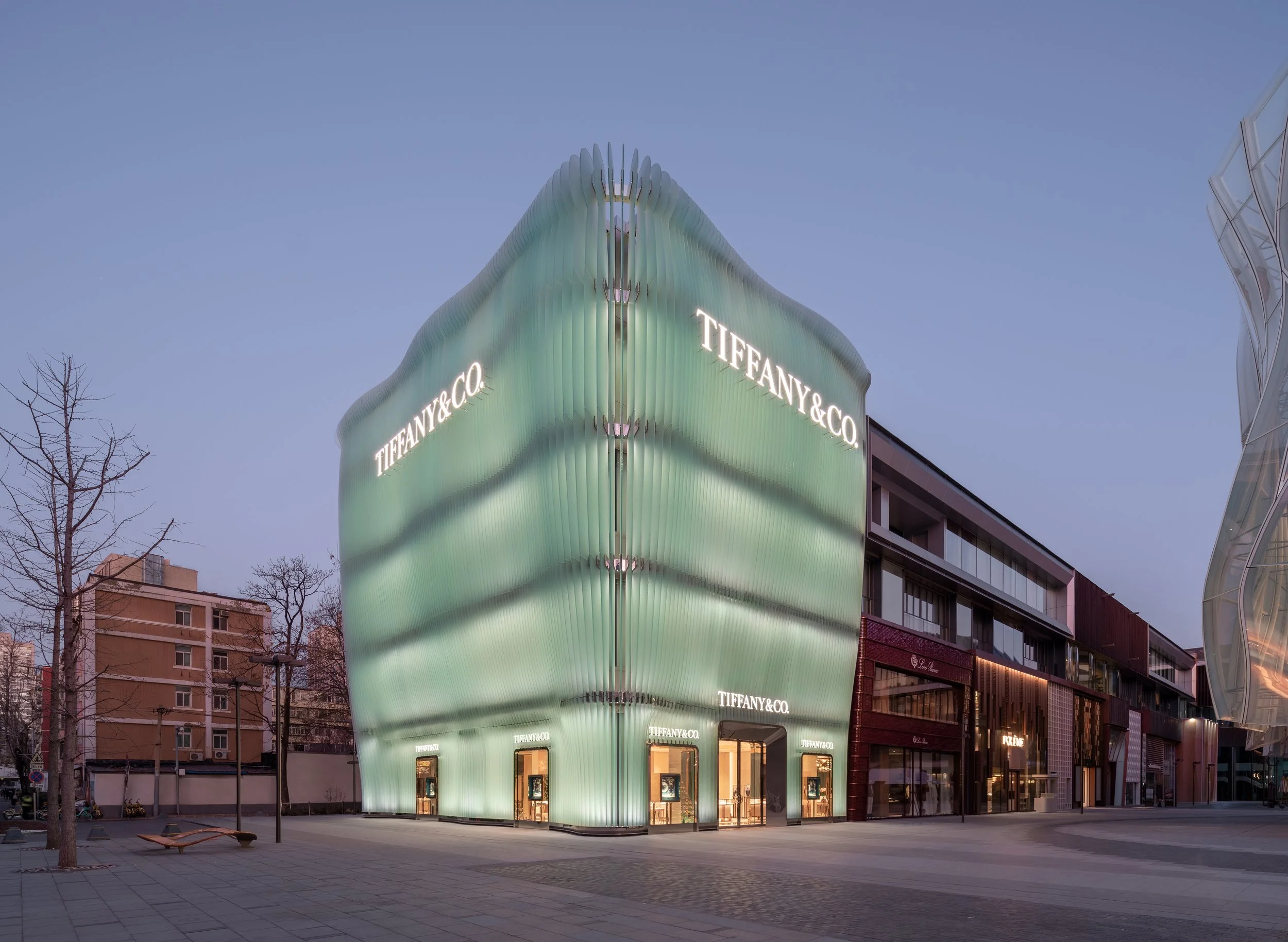
Tiffany & Co. Façade Beijing, MVRDV, 2025. © Tiffany & Co. Courtesy MVRDV.
A luxury retail facade is rarely where serious architecture happens. MVRDV's Tiffany & Co. flagship in Beijing's Taikoo-Li Sanlitun district is an argument against that assumption. The facade of curving, translucent glass fins rises the full four-storey height of the building, with flowing shapes inspired by the masterpieces of jewellery designer Elsa Peretti, specifically her Bone Cuff. The result is something between a building and a piece of jewellery at urban scale, which is precisely the point.
The glass carries a natural blue tone that becomes more pronounced as light passes through multiple layers. At night, integrated lighting embedded within the mounting brackets illuminates the fins evenly to create the soft glow long associated with Tiffany's visual language. The effect recalls the Art Nouveau tradition of treating a building's surface as ornament rather than enclosure, the way Victor Horta used iron and glass in Brussels to dissolve the boundary between structure and decoration. MVRDV does something similar here, but in the vocabulary of contemporary retail and parametric design.
The facade is designed to be demountable, allowing the glass fins and mounting brackets to be removed without damage, enabling the components to be reused or recycled at the end of their lifespan. That a building designed as pure spectacle is also engineered for circularity is the detail worth holding onto. The wave does not have to be permanent to be serious.
MVRDV, Tiffany & Co. Façade Beijing, Taikoo-Li Sanlitun, Beijing, 2025.