

A close looking at porcelain across Ming, Qing, and the Dutch East India Company
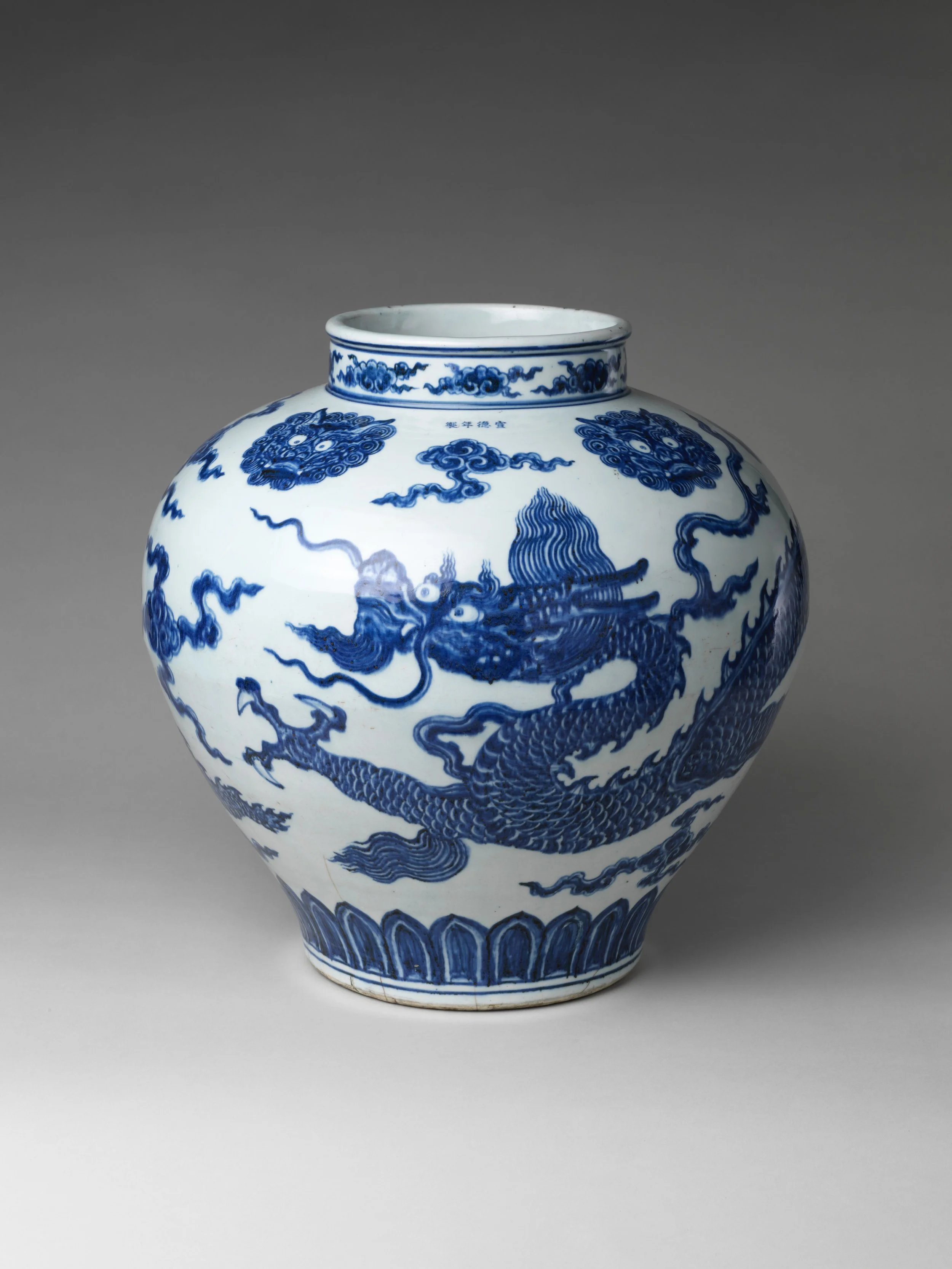
Jar with dragon, China, Ming dynasty, Xuande mark and period, 1426–35. Porcelain painted with cobalt blue. The Metropolitan Museum of Art, Gift of Robert E. Tod, 1937 (37.191.1).
Starting with the oldest, the Xuande jar, made in the imperial kilns at Jingdezhen sometime between 1426 and 1435, carries its maker's mark on the shoulder in two neat columns of script. White porcelain painted with cobalt blue first flourished in China in the fourteenth century and is arguably the most important development in the history of ceramics. The dragon on this jar does not decorate the surface. It commands it, a single creature coiling through sparse cloud across a form that gives it nowhere to hide. The cobalt is confident, the brushwork unhurried. This is imperial production at its most direct.
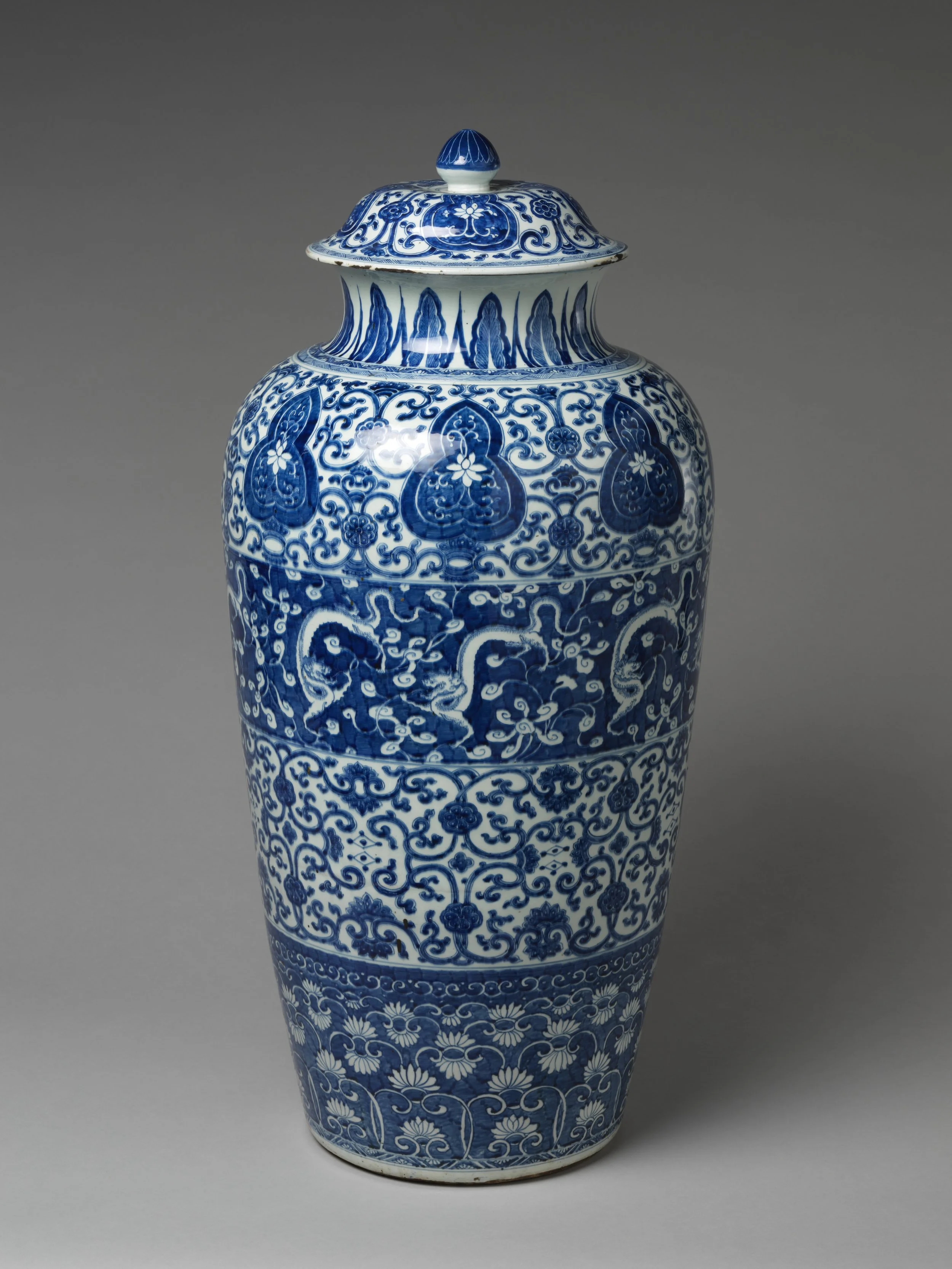
Jar with Dragons and Floral Designs, China, Qing dynasty, Kangxi period, late 17th–early 18th century. Porcelain painted with cobalt blue under a transparent glaze. The Metropolitan Museum of Art, Bequest of Mary Clark Thompson, 1923 (24.80.150a, b).
Jump forward two and a half centuries. The Kangxi jar, late seventeenth to early eighteenth century, shows what happens when the same Jingdezhen kilns turn up the density. Where the Xuande vessel breathes, this one accumulates. Dragons now share the surface with lotus scrolls, cloud collars, and registers of floral patterning that leave almost no white ground unoccupied. The cobalt has deepened in tone and the control of the brushwork is almost architectural. It is the same language spoken in a different register, richer, more complex, more conscious of itself as a luxury object destined for a world that was paying close attention.
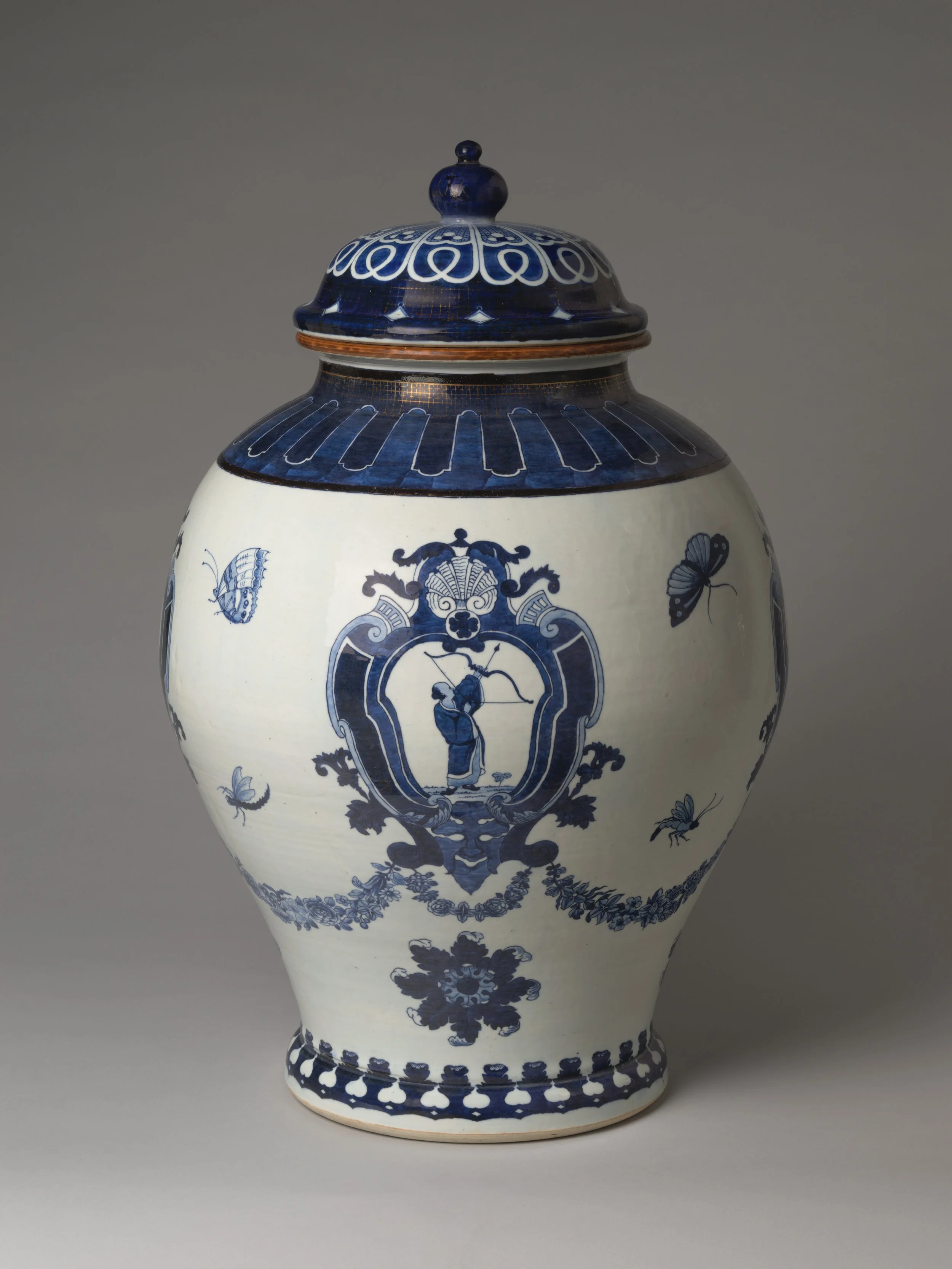
"The Archer" cistern, attributed to Cornelis Pronk, China, Qing dynasty, ca. 1740. Porcelain painted in underglaze cobalt blue. The Metropolitan Museum of Art, Gift of Shirley M. Mueller, M.D., 2021 (2021.321a, b).
The third object breaks the internal logic entirely. The Archer cistern is a rare example of Chinese porcelain with a design attributed to Cornelis Pronk, a Dutch draftsman working for the Dutch East India Company. In 1734 he was commissioned to make drawings for the decoration of Chinese porcelain, which were sent to China in 1736. A Western hand drew a figure in a baroque cartouche surrounded by European insects and butterflies, and Chinese painters at Jingdezhen reproduced it in underglaze cobalt onto a form that remains entirely Chinese. The result is disorienting in the best possible way. The grammar is Chinese. The vocabulary is Dutch. And somewhere between those two facts, a butterfly floats free of both.
What connects these objects across three centuries is not style, which shifts enormously, but material conviction. The cobalt does not waver. The white does not apologize. Whatever else changes, the fundamental commitment to this particular pairing of color and surface remains absolute. That consistency is itself a kind of argument, one that later artists from Ai Weiwei to Lei Xue have been answering ever since.